The answer comes back
Send frames to a brand's decision-maker as a link: a full-quality gallery with no account, keep or pass on every frame, and a circle drawn with a thumb where something is wrong. Every answer lands back in FLAM as a fact, not a sentence in an email thread. It costs nothing.
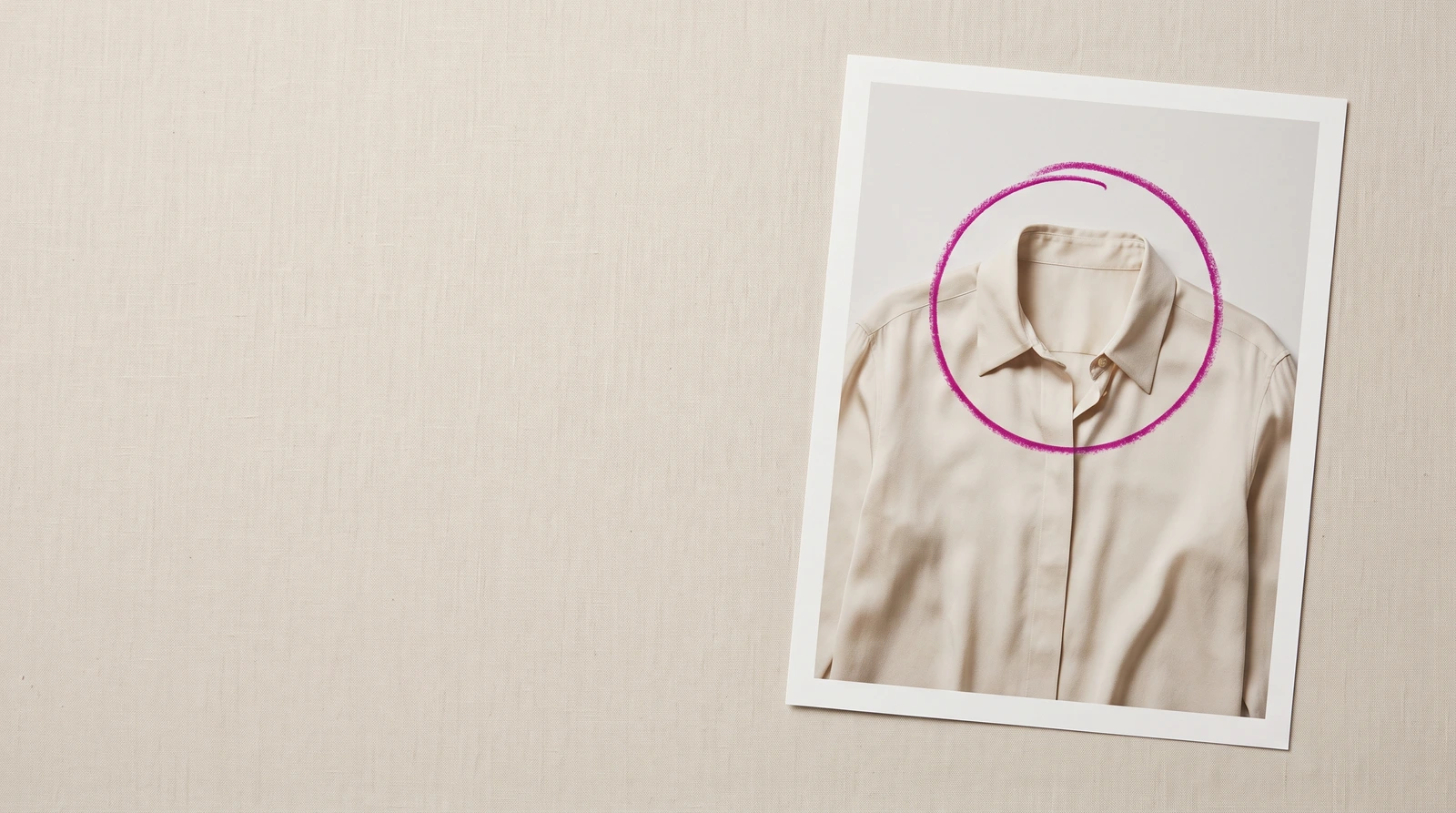
You can now send frames out for approval. Select them, mint a link, and the brand's decision-maker opens a gallery with no account: full quality, keep or pass on every frame, a circle drawn with a thumb where something is wrong. Every one of those answers comes back into your library as a fact. It costs nothing.
How do you send frames for approval?
Select the frames, choose to send them, and copy the link the house mints. But before the sheet asks you anything, it tells you something.
3 of these carry marks. Underneath, a choice: Review them, or Email all 14. Tap the first and a stroke crosses the sheet, and fourteen becomes eleven beneath it. The line exists only when it is true. If nothing is flagged there is no line and no magenta at all, because the house does not manufacture a warning to have something to say.
The frames travel in the order you chose them, and the gallery opens on frame 1, not on the frame the house scores highest. A first frame is a decision, and the decision is yours.
Why build this when WeTransfer exists?
Half of a send is parity: moving bytes at full quality. WeTransfer already does that perfectly, for free, and every brand knows how to open one. A better WeTransfer would be a year spent arriving second.
The other half is the approval loop, and nobody has it. A transfer tool hands over a folder and forgets it. It cannot know that three of the fourteen have a drawn hand in them, and the brand's yes comes back as a sentence in a thread your library cannot see. The house knows which frames it made, which its own read flagged, which you kept and which model wore them. It is the only party in the exchange that can turn "yes to these eleven" into a fact. That is what shipped: not a faster folder, an answer that comes home.
What can the person on the other end do?
Everything the review needs and nothing else. They walk the frames at full quality, keep or pass each one, leave a short note, and download any original. They see your house's name, the frames you chose and the expiry, and nothing else you have made.
And they can draw. A circle is one drag: press, pull, release. That is the only gesture a thumb does accurately, and most approvals happen on a phone between meetings. What travels back is never markup. A circle is stored as two points, a centre and radii, and the house draws those numbers in its own ink. No SVG, no HTML, no image data is ever accepted or stored. The coordinates are normalized, so a stroke drawn on a phone lands on the same part of the same frame on a 5K display. A pixel coordinate is a lie the moment the viewport changes. The whole value of a circled collar is that it stays on the collar.
One ink, one weight, no colour picker, no arrows, no layers, and no eraser beyond undo. Up to 20 marks fit on a frame, in practice as many as you like.
The numbering earned its place. Each mark carries an optional one-line note, and in the first build the notes were numbered while the ink was not. Our founder opened his own link and asked how anyone could tell which drawing was 1, 2 or 3. Now every stroke wears its numeral on the frame itself. Tap a numeral and its note lights. Focus a note and its ink comes forward while the others rest.
Does a keep mean the frame is approved?
No, and keeping the two apart is the feature's most important decision. A recipient's marks are evidence: what a named outsider said, timestamped, and possibly contradicted by another outsider. Approval is the decision, a flag only you set. The house never flips it for you, not even on a unanimous keep.
Approval works with zero sends. Decisions arrive by phone, in a showroom, over WhatsApp, in meetings the house was not in. A house where approved can only mean "a link came back" is a house that is wrong about most of its own work.
Disagreement is shown, never resolved. Maya keeping frame 7 while Tom passes it is the most important thing on the screen, and a house that quietly computed a winner would have hidden the one fact you needed.
What the house will do is offer. One line: "Maya approved 12 of 14." One action: "Approve those 12." Underneath it: "This costs nothing." You confirm it or you don't. A collection then tells you a single number: 3 pieces have no approved frame. Approved there means your decision, not a recipient's keep.
Is the link safe to send?
The token sits after the hash in the URL, the part a browser never sends to any server. It never lands in an access log, a referer header, or any proxy between you and the brand. A capability link in a query string ends up in six log files. This one is in none. A link pasted into Slack unfurls into a card that cannot fetch your frames, so an unreleased campaign cannot leak into a channel of forty.
Every wrong door answers the same 404. Expired, revoked, deleted and never-existed are byte-identical, so the link gives nothing away under probing.
A link lives 30 days: 7 is a support ticket, 90 is a leak with a long tail, and 30 covers one round of a slow brand's calendar. You can revoke earlier, in one tap.
One limit, said plainly rather than found out: revoking a link stops new reads. It cannot un-download what someone already took.
What does finishing look like?
The first person to finish a link was our founder, and he left two notes doing it. Opening the gallery: "I have no idea what I'm supposed to do here as an approver." And after the last frame, that he wanted her to know he had finished his judgments. Both became copy.
The gallery now opens by saying what it is for: open each frame, keep it or pass it. Keep and Pass are the largest type on the panel, and the chosen one fills solid and stays solid. In the first build they were small grey type in a corner. He read the arrows first and never found them.
At the end there is one verb, "Send my answers", and after it a real close: every keep, every pass and every note went through, and you can close this tab. The first build said one sentence and stopped, a strange note to end on after twenty minutes of careful work.
Then your bell rings. "Maya at Ganni finished. 9 kept, 5 passed." A letter reaches you, because the whole point of the send is that you posted a link and went back to work. The letter is a count, never a verdict, and it closes on the sentence the feature stands on: "Nothing is decided until you say so. The marks are theirs; the approval is yours." Hit reply and your answer lands with Maya, not with us.
A second tap never sends a second letter, and finishing with nothing marked is refused. There is no news in it.
What does a circle make possible?
A circled collar with a note is already a region. The house can hand it straight back to a redraw as an instruction that reads "the collar area", ranked above the brand vision. The brand's own finger, inside the instruction, in one tap. Nobody else can offer that, because nobody else holds both the review and the machine that develops the frame.
What is not here yet
- A zip. Fourteen frames download as fourteen files, one at a time. The archive is a separate piece of work, and we would rather name the gap than imply it closed.
- Mail to the recipient. The house never emails the person you send to. You copy the link and send it the way you already send things. Mailing a stranger's inbox is its own responsibility, and it will be done properly or not at all.
Related
- How the send works, step by step: the send docs.
- What shipped, and when: /changelog#the-send.
Questions
- How do I send frames to a brand for approval?
- Select the frames and mint a link. The brand's decision-maker opens a full-quality gallery with no account, keeps or passes each frame, leaves a short note where they want to, and can circle a region directly on the image with a thumb. Every answer lands back in your library the moment they send it.
- Does the person reviewing the frames need an account?
- No. The link opens a gallery with no sign-in, no email asked for, and no cookie set. They see the frames you chose, your house's name and the link's expiry, and nothing else: no other frames, no internal names, no prices.
- Does sending frames for approval cost tokens?
- No. The link, the full-quality frames, the downloads and the answers coming back are all free. Nothing on this path is billed.
- If a recipient keeps a frame, is the frame approved?
- No. A keep is evidence of what one named reviewer thought, with a timestamp. Approval is a separate flag only the director sets, and it is never set automatically, not even when every reviewer kept the frame. Decisions also arrive by phone and in showrooms, so approval works with no link at all.
- How long does an approval link last, and can I revoke it?
- A link lives 30 days, and you can revoke it in one tap at any time. Revoking stops all new reads immediately. It cannot un-download a file someone already saved, which is true of every sharing tool and worth saying plainly.